
Number Crunched: How AI Is Rewriting the Finance Career Playbook
by Ricky Nutt
You used to hire analysts to tell you what the numbers actually meant. Now a machine does it in seconds.
Finance has always sold itself on two things; rigor and reliability. Graduate scheme. Analyst. Associate. Manager. Director. CFO.
That path still exists.
The problem is AI just automated the bottom half of it.
The Old Model
Junior analysts earned their judgment through repetition; building models, reconciling reports, running due diligence on documents nobody senior wanted to touch. That friction was the point. By the time you made Associate, you’d seen enough to know when something didn’t look right before the model flagged it.
That constraint is now disappearing.
What AI Is Actually Doing to the Work
The tools are deployed. The workflows are already changing. AI is now handling:
- Financial modelling – copilots and LLMs drafting, sense-checking, and iterating models in minutes
- Variance analysis and reporting – automated narrative generation from raw data
- Due diligence document review — hundreds of contracts processed in hours, not days
- Regulatory and compliance monitoring — continuous, real-time, no human input required
- FP&A outputs — forecasts, scenarios, and dashboards on demand
The Big Four are deploying AI at scale internally. Goldman Sachs is automating across legal, compliance, and trading. JPMorgan, HSBC, and BlackRock are running similar programmes. Graduate and analyst intake is quietly, steadily shrinking. That’s not a coincidence.
The Entry-Level Problem
AI does the foundational work faster and cheaper. So companies face a straightforward calculation; why hire five analysts when two senior hires and an AI workflow delivers more, more accurately, with no onboarding lag?
The result; fewer entry roles, higher bars, and “day one impact” expectations placed on people with zero experience. January 2025 saw professional services job postings hit a decade low. Forty percent of white-collar candidates in 2024 failed to secure a single interview.
Nobody sent a memo. The roles just quietly stopped appearing.
Where Finance Is Actually Growing
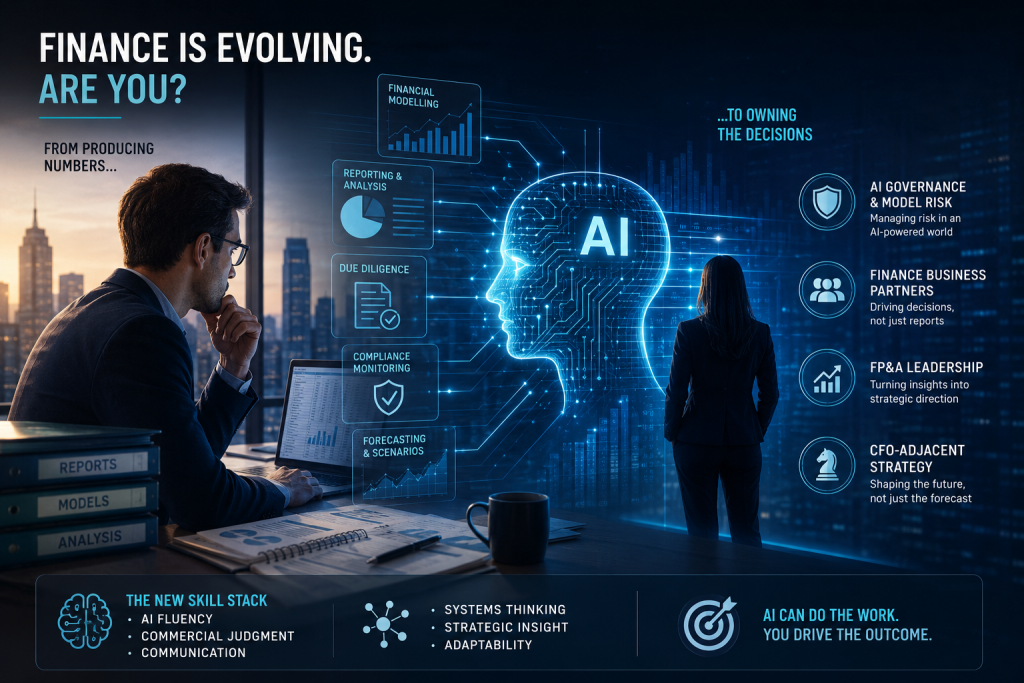
Demand is shifting toward roles that sit above the automation layer:
- AI Governance and Model Risk – as firms rely on AI-generated analysis, professionals who understand model limitations and failure modes are increasingly in demand.
- Finance Business Partners – embedded in commercial teams, translating data into decisions. Not producing numbers; owning the narrative around them.
- FP&A Leads – interpreting outputs, challenging assumptions, connecting financial signals to strategic direction. Judgment under uncertainty: the work AI can’t do.
- CFO-adjacent Strategy – as operations automate, the CFO function is evolving toward capital allocation, investor relations, and commercial leadership.
The direction of travel – from producing numbers to owning the decisions those numbers inform.
The New Skill Stack
The finance professional who thrives here isn’t the best modeller in the room. They’re the one who knows what the model is missing.
AI Fluency – Knowing what to trust, what to challenge, and when the output needs a human call.
Commercial Judgment – Connecting financial outputs to business decisions — not just reporting what happened.
Communication – Translating complexity into boardroom language. Concise, confident, directional.
Systems Thinking – Designing the workflow, not running it. Building the process rather than executing it.
AI can model. It can optimise. It can forecast. It can’t own the outcome.
Hiring Is Now a Strategic Decision
Finance leaders face the same dilemma as their counterparts in tech and marketing. Short-term; fewer, senior, AI-enabled hires delivering maximum output. Long-term; redesigning entry-level roles to build the next generation of finance leaders.
Most firms are choosing efficiency. The pipeline problem is five to seven years away. Most CFOs aren’t thinking about it yet. They soon will be.
The Reality for Candidates
In theory, the old path – graduate scheme (two years of analyst work, steady progression) still exists in name.
In practice, the floor has risen.
The market isn’t hiring for execution capacity. It’s hiring for judgment, fluency, and the ability to drive value from day one;
- Demonstrate AI-assisted work — don’t hide it
- Think end-to-end, not just within your function
- Show outcomes, not activity
- Build skills above the automation layer before the market demands them
If you’re just producing outputs – you’re exposed. If you’re directing what happens with them – you’re valuable.
What TYP Can Do
Most finance teams don’t have a talent problem. They have a definition problem. They are still writing job descriptions for roles that no longer exist.
At TYP Group, we help finance functions redefine roles for an AI-driven operating model, identify high-leverage talent above the automation layer, and build hiring strategies that balance short-term efficiency with long-term capability. For candidates, we position you for where the market is moving, not where it’s been.
AI isn’t removing finance jobs.
It’s absorbing the entry point and elevating the roles that remain.
The spreadsheet won’t save you.
Knowing what to do with it will.
At TYP, we’re not just tracking how the employment market is changing – we’re focused on where it’s going next. Through TYP Engage, we help businesses and talent anticipate shifts, not react to them.
This article is part of a wider series exploring how AI and data-led technologies are reshaping industries, and what that means for hiring, career progression, and long-term workforce strategy.
Because the reality is simple; the market isn’t waiting for you to catch up. It’s already moving.